Specialized Wound Care
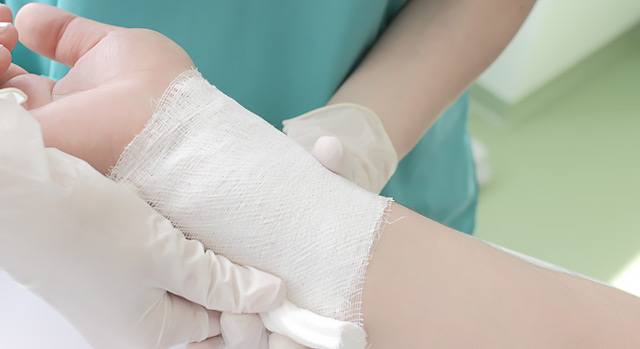
Some wounds require specialized and aggressive medical treatment, while others heal on their own with a bandage and a little patience. The more serious wounds, commonly called non-healing wounds, are caused by a wide variety of conditions, including:
- Diabetes
- Pressure ulcers (often caused by arthritis)
- Circulatory problems
- Traumatic injuries
- Surgical incisions
- Compromised skin grafts
Whether it be through our outpatient treatment center or inpatient care, the Summerlin Hospital Medical Center Hyperbaric and Wound Care Program offers a complete range of services, including:
- Wound evaluation
- Wound debridement
- Advanced wound care technology
- Compression therapy
- Vascular diagnostics
- Diabetic education
- Nutrition management
- Antibiotic outpatient coverage
Our program provides the latest wound care treatments, as well as the experienced care of a team of physicians and nurses who specialize in wound care management. In addition, the Hyperbaric and Wound Care Program offers care in a quiet, suburban setting, far from the noise and congestion of central Las Vegas.
Hyperbaric Oxygen Therapy
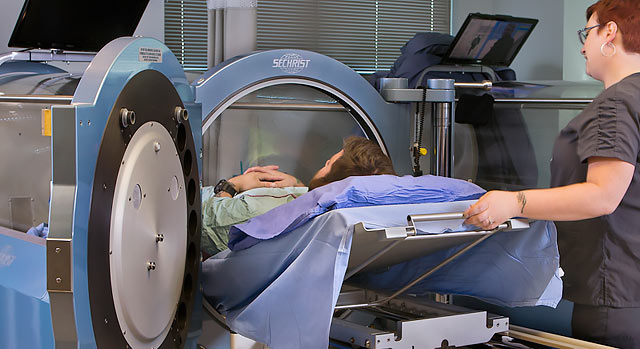
Hyperbaric Oxygen Therapy (HBOT) is a procedure in which a patient breathes 100 percent oxygen at pressures two to three times greater than the atmospheric pressure at sea level. This dissolves more oxygen in the bloodstream, which delivers it to every part of the body.
Hyperbaric oxygen can be delivered in hyperbaric chambers made of clear acrylic and filled with 100 percent oxygen. Hyperbaric oxygen treatments are normally painless and the average session is about two hours. During your treatment you can listen to music, watch TV, or take a nap in the chamber.
Treatments are scheduled daily, Monday through Friday.
Hyperbaric oxygen can be applied as a primary or secondary treatment for many conditions including bone infection that does not respond to standard treatment, crush injuries and reattachment of severed limbs, deep tissue injury from radiation therapy and skin grafts or flaps that are not healing.
How Does HBOT Work?
The air we breathe every day is made of 21 percent oxygen, 78 percent nitrogen and other gasses at an air pressure of approximately 14.7 pounds per square inch.
Inside the hyperbaric chamber, patients breathe 100 percent oxygen while the pressure is gradually increased two to three times the normal outside air pressure. That allows the patient's body to absorb 10-20 times more oxygen than he or she would regularly absorb. That, in turn, causes oxygen-rich blood to flow to the wound site, speeding the wound healing process, and leading to a number of benefits including:
- A decrease in localized swelling
- The formation of new micro blood vessels
- Increased protection against infection
- Decreased effects from harmful or toxic substances in the body
- Enhanced wound healing
Goals of Hyperbaric Therapy
While the primary goal of hyperbaric oxygen therapy is to help heal wounds, each patient may have different goals regarding his or her outcome. For example, some people may have hyperbaric oxygen therapy to help reduce infection or decrease extensive swelling. Others may use HBOT to help prevent further deterioration of existing tissue. Not all patients respond to HBOT the same way, so it is difficult to predict outcomes with certainty.
Hyperbaric oxygen therapy works from the inside of the body out, so improvement in the patient's condition may not be immediately visible. Patients are typically re-evaluated during the course of treatment to determine if the maximum benefits of HBOT are being achieved.
Hyperbaric Staff
The staff at the Hyperbaric and Wound Care Program is made up of certified hyperbaric technologists and specially trained physicians and nurses. All have attended formal courses and have met or exceeded standards for all areas of hyperbaric medicine.