
Robotic Procedures
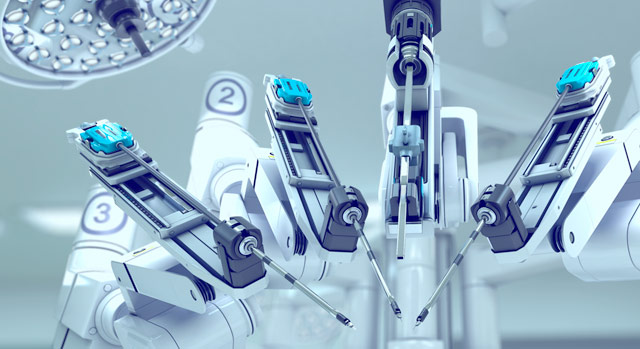
Surgeons at Summerlin Hospital Medical Center use robotic surgery for gynecologic procedures, prostate surgery, kidney surgery, gallbladder surgery and other procedures. Potential benefits of minimally invasive robotic surgery over open surgery may include a shorter hospital stay, less post-operative pain, a quicker recovery, less risk of infection and less scarring.
Robotic gynecologic surgery
For some women, robotic gynecologic surgery may be a good alternative to open surgery or standard laparoscopic procedures. Open gynecologic surgery, in which a large incision is made in the abdomen so a surgeon can access the uterus and surrounding anatomy, has been the standard approach to gynecologic procedures for years.
However, open surgery can cause significant pain, physical trauma and a long recovery process. The potential advantages of laparoscopic and robot-assisted laparoscopic hysterectomy and other gynecologic procedures over conventional open surgery include smaller incisions that may result in less post-operative pain, reduced blood loss and less need for blood transfusions, and a potentially faster recovery and return to normal activities.
Robotic prostate surgery
Studies indicate that one of the most effective treatments for prostate cancer is radical prostatectomy, the surgical removal of the prostate and surrounding cancerous tissues. US surgeons generally use one of three approaches: open surgery (which requires a large incision in the patient's abdomen) or laparoscopic or robotic-assisted laparoscopic surgery.
Regardless of the surgical method, the surgeon's goal is the same: remove the prostate gland from the surrounding tissue. The seminal vesicles, two small fluid-filled sacs next to the prostate, are also removed. The surgeon's goal is to cause as little damage as possible to nerves and blood vessels in the surrounding area.
The potential advantages of laparoscopic and robotic-assisted laparoscopic prostatectomy over conventional open surgery include smaller incisions that may result in less post-operative pain, reduced blood loss and less need for blood transfusions and a potentially faster recovery and return to normal activities.
Robotic kidney surgery
The kidneys are two fist-sized organs located near the middle of the back, just below the rib cage. Kidneys remove waste products and extra water, which become urine. The urine flows through tubes called ureters to the bladder. Kidneys can become damaged by several conditions including diabetes, high blood pressure, cancer, cysts, stones and infections. Genetic problems, injuries and medicines can also cause chronic kidney problems.
Many kidney surgeries have required removal of the entire kidney, called a radical nephrectomy, which is an open procedure that requires a six to eight inch incision. But even partial nephrectomy, in which part of the kidney is removed, has required an open procedure. This means that patients have not, until recently, had the option of laparoscopic surgery, which is minimally-invasive surgery using small incisions.
The da Vinci® Surgical System is used to perform robot-assisted laparoscopic surgery for kidney patients. Because of the precision of this type of laparoscopic surgery, kidney patients now have a laparoscopic option both for radical and partial nephrectomy.
Robotic lung surgery
Collecting tissue samples for lung biopsies should be safe and minimally invasive. More than 95% of suspicious lung nodules are benign, and yet a lung care specialist may prescribe an Ion bronchoscopy to test for cancer cells.
The Ion robotic system from Intuitive helps doctors perform diagnostic bronchoscopy procedures using fiber optic sensors designed to enhance surgical precision. For minimally invasive lung biopsies, robotic-assisted Ion technology can also reach deeper into parts of the lung using 3D diagnostics.
Robotic colorectal surgery
During a robotic colectomy, surgeons remove cancerous portions of the colon and rectum, as well as benign tumors and polyps. A robot-assisted approach provides surgeons with the tools to more easily connect the two ends of the colon after the cancer has been removed. The procedure can be completed with a few tiny incisions, rather than the one long incision used in traditional open colon surgery.
Robotic surgery allows surgeons to perform complex rectal cancer surgery, which had been extremely challenging, in a minimally invasive manner. The robot provides improved visualization of the surgical site through 3D magnification, enhanced dexterity for manipulation and dissection of tissue, and greater precision.
The robotic procedure allows surgeons to finely dissect cancers of the rectum while possibly reducing nerve injury. A recent study has shown that surgeries using the robot are less likely to require conversion to an open procedure than colorectal procedures performed laparoscopically.
Single-site robotic gallbladder surgery
Treatment for gallbladder disease generally includes lifestyle and dietary changes and medication. However, in some cases, doctors recommend cholecystectomy, which is surgery to remove the gallbladder.
Although minimally invasive cholecystectomy has been used for several years, a new surgical refinement, in which only one incision, in the navel (belly button), is made to perform the gal bladder surgery. Doctors at Summerlin Hospital use the da Vinci® Xi Surgical System, a refinement to the standard da Vinci system.
Because there is only a single, small incision, patients often experience less trauma to the body and less blood loss during the gall bladder robotic surgery. This means they may recover quicker, and return to work and daily activities faster, than they would with conventional surgery.
Individual results may vary. There are risks associated with any surgical procedure. Talk with your doctor about these risks to find out if robotic surgery is right for you.